
Tankless vs. Traditional Water Heater: Which Is Right for Your Naperville Home?
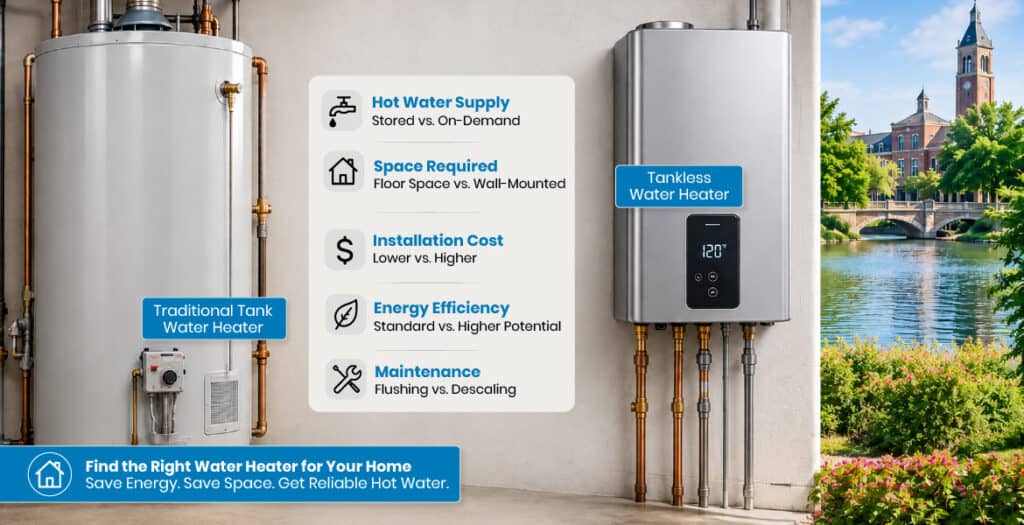
When there is a need to replace a water heater, it might be difficult to understand which system you should choose. In Naperville, factors like water hardness, winter temperatures, household size, and hot water usage all play a role.
This guide compares both options to help you compare the costs, maintenance, and long-term value of each system.
How Traditional and Tankless Water Heaters Work
Traditional Tank Water Heaters
Traditional water heaters store a large amount of water, typically 40 to 50 gallons, inside an insulated tank. A gas burner or electric heating element keeps the water heated.
Tankless Water Heaters
How Naperville’s Hard Water Affects Your Water Heater
When choosing a water heater, many homeowners consider size and price but often forget about the water that runs through the system every day.
Naperville receives its water from Lake Michigan through the DuPage Water Commission. Like much of the Chicago area, the water contains minerals such as calcium and magnesium that make the water harder.
Water hardness in the area is typically around 8 to 8.8 grains per gallon, which may cause mineral deposits to form over time.
How Hard Water Affects Traditional Water Heaters
In a traditional tank system, minerals settle at the bottom of the tank and create a layer of sediment. This buildup reduces heating efficiency because the burner has to work harder to heat the water.
If you flush the tank regularly, it can remove these deposits and operate more efficiently.
If you have a tankless water heater in Naperville, regular descaling is an important part of its maintenance. Annual maintenance or a water softener can prevent mineral deposits and make the system last longer.
How Naperville Winters Affect Water Heater Function
Naperville winters bring another challenge for homeowners as colder water temperatures require more energy to heat.
During summer, the water supplied to your home may already be relatively warm. However, in the middle of winter, water supply temperatures can drop significantly, sometimes reaching between 38°F and 50°F.
Your water heater must then work harder to raise the water to a comfortable level, usually around 120°F.
One of the biggest differences between these systems is their initial installation cost.
Feature | Traditional Tank Water Heater | Tankless Water Heater |
Installation Cost | $2,000-$5,000 | $5,500-$8,500 |
Average Lifespan | 8-12 years | 20+ years |
Hot Water Supply | Limited by tank size | Continuous supply |
Space Required | Requires floor space | Wall-mounted design |
Energy Efficiency | Standard performance | Higher efficiency potential |
Maintenance | Annual flushing recommended | Regular descaling required |
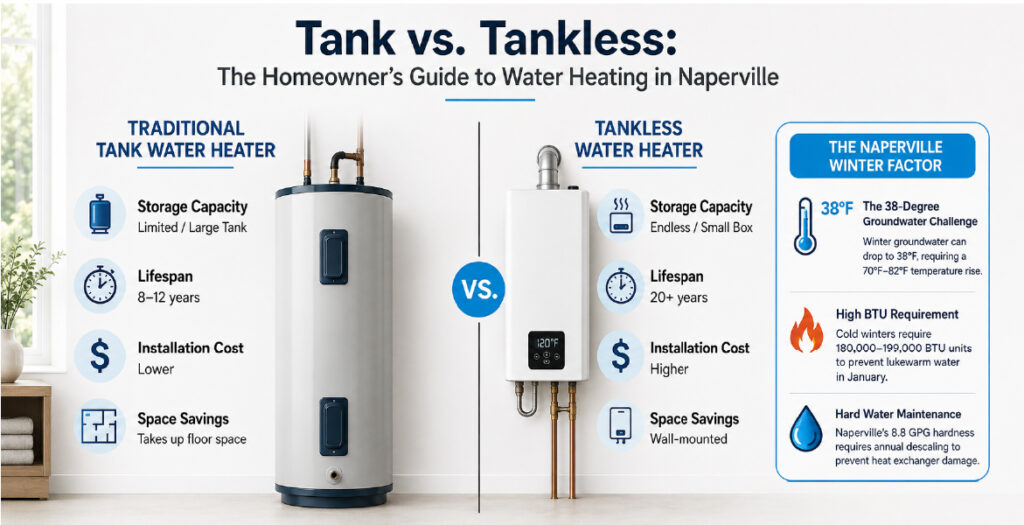
However, tankless units often last much longer and can reduce energy waste because they only heat water when needed.
When you want to switch from a traditional water heater to a tankless model, it not only involves replacing the unit but may also require upgrades to your home to support the new system.
Gas tankless water heaters need a higher gas flow because they heat water instantly. Some homes may require larger gas lines to support the new system.
Venting Changes
Some homes may need a gas meter upgrade to ensure the water heater can operate properly alongside other appliances, such as furnaces or dryers.
These additional requirements increase installation costs but ensure the system operates safely and efficiently.
Which Water Heater Offers Better Long-Term Value?
Factor | Traditional Tank Water Heater | Tankless Water Heater |
Upfront Cost | Lower initial investment | Higher installation cost due to equipment and possible upgrades |
Lifespan | Usually lasts 8-12 years | Can last 20+ years with proper maintenance |
Maintenance Needs | Requires regular flushing to remove sediment buildup | Requires periodic flushing and descaling |
Energy Use | Uses energy to keep stored water hot even when not in use | Uses energy only when hot water is needed, reducing standby heat loss |
Long-Term Value | Better choice for homeowners looking for lower upfront costs | May provide better value for homeowners planning to stay long-term |
Best For | Budget-conscious homeowners or those planning to move within a few years | Homeowners who want longer lifespan, space savings, and continuous hot water |
Bottom Line: Traditional water heaters cost less upfront, while tankless systems can offer better long-term value with proper maintenance.
- You want a lower installation cost.
- Your household has moderate hot water needs.
- You plan to move within a few years.
- You prefer a simpler system with familiar maintenance needs.
- Your family frequently experiences a shortage of hot water.
- You want to save space.
- You plan to stay in your home for many years.
- You want a system that provides hot water whenever you need it.
- You are comfortable with regular maintenance.
Tankless and traditional water heaters both have their own benefits. A traditional tank system usually costs less to install, while a tankless unit saves space and provides hot water whenever you need it. If you need help choosing the right system or need a Naperville plumber for plumbing solutions, visit our Emergency Naperville Plumber page
The best option depends on your household needs, budget, and plans. Whichever system you choose, it’s important to keep up with regular maintenance to prevent unexpected issues.
FAQs
A tankless water heater can be a good investment for homeowners who need more hot water, want to save space, and plan to stay in their home for many years. However, proper sizing and maintenance are important because of Naperville’s hard water and cold winters.
Most traditional tank water heaters last around 8 to 12 years with regular maintenance. Flushing the tank and addressing small issues early can help extend its lifespan.
A properly maintained tankless water heater can last 20 years or more. Regular descaling is important, especially in areas with harder water.
Yes, but the unit must be properly sized. A small tankless system may struggle when multiple showers and appliances run at the same time.
Yes, but the unit must be properly sized. A small tankless system may struggle when multiple showers and appliances run at the same time.